A Founder's Blue Cruise — Four Days on the Lycian Coast
Every coastline across the Mediterranean possesses its own distinct character. The sheer cliffs of the Amalfi Coast and the wind-swept islands of the Aegean offer very different travel rhythms; the Lycian Coast of Turkey finds its balance through sheltered coves, pine forests descending to the shoreline, and deep, calm anchorages. Here, the cadence of the day is guided less by a fixed schedule and more by the angle of the light, the depth beneath the hull, and the stillness of the water.
In August 2026, I embarked on a four-day voyage from Göcek with a party of four to experience firsthand the craft and practical logistics of a private Turkish Blue Cruise. Beyond reviewing floor plans or specifications, the journey provided an opportunity to observe how vessel choice, crew dynamics, anchorage selection, and sensible pacing shape the quality of time spent at sea.
The Vessel and Crew Dynamics
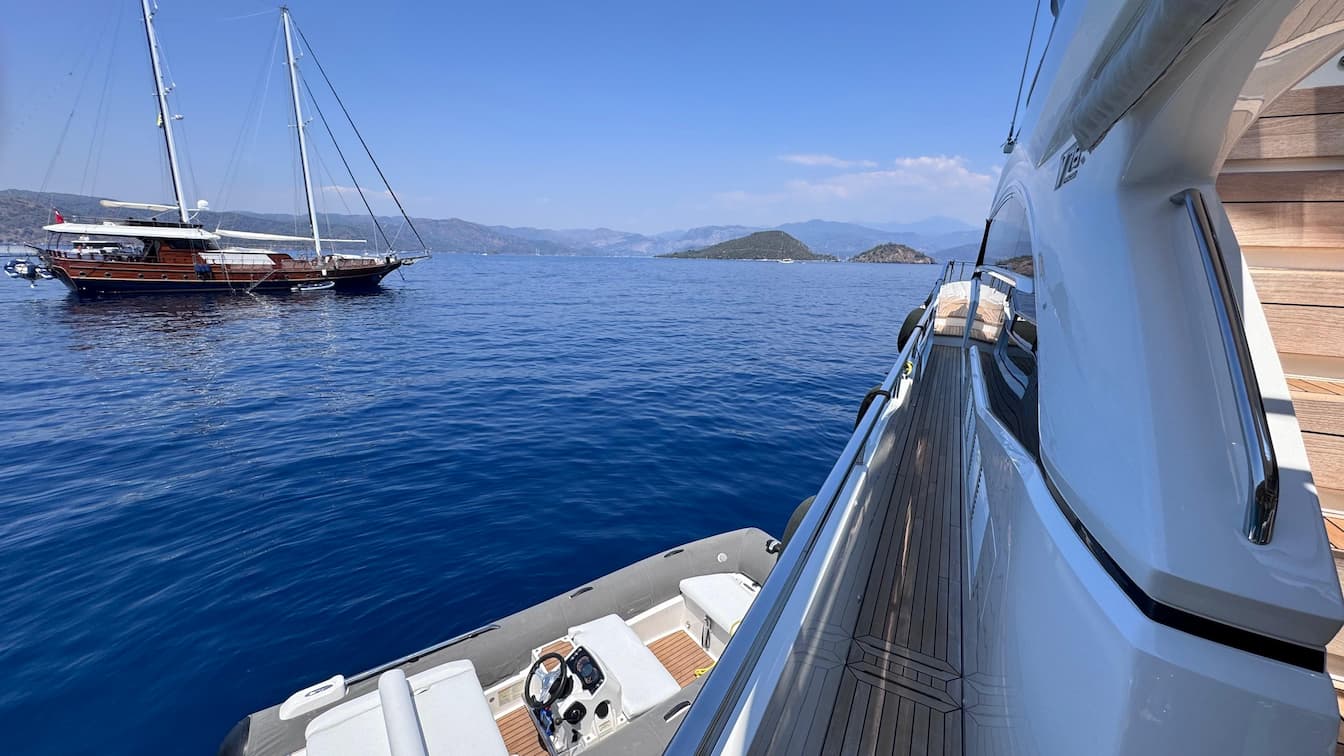
Our yacht for this passage was a 2020 Princess Y78, an English motor yacht configured with four guest cabins and zero-speed stabilizers. Hosting four guests aboard a vessel designed for eight offered generous private accommodation and comfortable shared deck areas. The motor propulsion provided scheduling flexibility against variable afternoon thermal winds, while the gyroscopic stabilizers noticeably reduced hull motion at anchor, making extended periods in the bays significantly more restful.
Yet the primary tone of the voyage was set by the crew rather than the mechanics of the vessel.
The yacht was operated by a two-person team: a captain and his wife, who handled deck duties, service, and cooking. On larger commercial charter yachts, service can sometimes feel formal or compartmentalized. Here, the rhythm was understated and personal. Meals were cooked aboard, centered around traditional Aegean and Turkish staples: fresh sea bass, meat courses, köfte, seasonal vegetables gently braised in local olive oil, and small spreads of meze. There was no elaborate menu; the cooking was honest, prepared directly on board, and well suited to the midday heat.
The Route: Tersane, Hamam Koyu, and Tomb Bay
Rather than navigating a crowded itinerary of several anchorages per day, we prioritized fewer stops and longer stays.
- Night 0 (Göcek Marina): We boarded at Göcek Marina for an overnight stay prior to departure. For travelers arriving after a long-haul journey, this arrival buffer allows time to rest, unpack, and adapt before slipping lines. After walking the waterfront paths in the evening, we dined aboard; setting out early the following morning ensured a relaxed departure into open waters.
- Day 1 (Tersane Island): A historically sheltered anchorage bordered by historic shipyard and settlement remains along the shoreline. Anchoring early in the morning granted several quiet hours before regional day excursion craft arrived in the bay.
- Day 2 (Hamam Koyu): Bypassing the shallow, busier sections near the submerged masonry known locally as Cleopatra's Bath, we positioned the yacht near the outer, seaward opening of the bay. The water here was deeper and clearer, with pine branches overhanging the rocks, creating ideal conditions for swimming.
- Days 3 & 4 (Tomb Bay / Taşyaka): By Sunday, boat traffic increased throughout the neighboring anchorages. Instead of searching for an alternate cove, we chose to remain anchored in the calmest pocket of Tomb Bay for two consecutive nights. With the stabilizers minimizing wake movement, staying in one location proved to be one of the most restorative decisions of the journey.
Stern-to-Shore Mooring and the Water's Rhythm
In the narrow, deep inlets characteristic of the Göcek region, conventional swinging at anchor is not always practical. Instead, yachts frequently utilize stern-to-shore mooring (kıçtan kara). The bow anchor is dropped toward open water, the stern is reversed close to the shoreline, and lines are secured ashore to rocks or coastal pine trees.
This method keeps the yacht steady and prevents it from pivoting with changing breezes. On our journey, after the crew swam lines ashore to tie off, the body of water enclosed between the aft swim platform and the rocky shore formed an enclosed, calm pool. Over four days, the color of these depths shifted predictably: dark navy in water exceeding twenty meters, rich forest green where the pine canopy met the shoreline, and pale turquoise over shallow patches of limestone sand.
Our days settled into an unhurried pattern punctuated by five or six swims between meals. But the most memorable observation of the journey was simple: swimming in the sea in the quiet hours before breakfast, choosing to wake up directly in the water rather than on land. The glass-like stillness of an early bay at sunrise provides an experience of coastal travel that shore-based hotels rarely match.
Antiquity on the Cliffs
Tomb Bay takes its name from the Lycian rock-cut tombs visible in the cliffs above the anchorage.
We observed them from the deck through binoculars rather than climbing the steep stone scree. There was no guide aboard to narrate their history; the monuments simply stood in silent contrast to the modern yachts below.
After the trip, I looked into their background: they date generally to the fourth century BCE or earlier. The ancient Lycians developed a distinct civilization with a notable federal system, leaving behind numerous rock-cut tombs along this coastline. Looking up from morning coffee to see classical stone architecture carved directly into the rock is a quiet reminder of the deep human history rooted in these shores.
Practical Insights for Blue Cruise Design
Experiencing this voyage firsthand clarified several practical considerations for designing thoughtful coastal itineraries:
- Vessel selection and journey scale: Yacht selection is not governed by a single prescriptive dimension; it depends on group size, cabin layout, intended route, vessel draft, and operational requirements. On our four-person voyage, the Princess Y78 demonstrated how a vessel of this scale can provide generous private space while retaining the agility required for narrower coves.
- Crew cohesion: Small, well-integrated crews often establish a more personal, relaxed atmosphere than larger service teams.
- Pacing over volume: Attempting to visit multiple coves each day can compromise the primary appeal of a yacht charter. During busy periods, remaining at a quiet anchorage is frequently more rewarding than frequent transits.
- Arrival buffers (Night 0): An initial night docked at the marina allows long-haul travelers to adjust to time changes and settle into life aboard before departure.
- Weather and flexibility: Wind patterns and seasonal maritime traffic inevitably affect conditions. An itinerary should retain the flexibility to adapt to operational realities rather than strictly enforcing a rigid schedule.
At Throne Voyages, our broader perspective on travel across the country is articulated within Turkey Designed: Private Collection. To discuss planning a private coastal journey shaped by these considerations, explore our Bespoke Travel planning approach, or consult our teams regarding Concierge services and Transportation arrangements.
If you are considering a private Blue Cruise along the Lycian Coast, contact our team with your preferred dates and priorities, and we can discuss designing an itinerary suited to your pace.
Design Your Private Lycian Blue Cruise
Four days, seven, or longer — share your travel dates, group size and priorities, and we will shape the vessel, route and pacing around them, working with the realities of season, weather and the bays themselves.